


Technology has constantly changed the diagnosis and treatment landscape in the healthcare industry. An extremely promising advance in this way has been computer vision, a branch of artificial intelligence (AI) that gives machines the ability to see and analyze visual data. This has revolutionized diagnostics, from detecting anomalies in medical images to assisting radiologists in the early identification of disease. The role of AI in computer vision is crucial, as it enables machines to learn from the data they process, improving their ability to identify diseases. But how exactly is this technology helping in disease detection at an early stage? Let’s get into it.
Computer Vision in Healthcare
Computer vision enables deep learning and algorithms for image processing upon medical images, namely X-ray, MRI, CT scan, and histopathological slide. For instance, it can analyze X-rays to detect fractures or tumors, MRI scans to identify brain abnormalities, and histopathological slides to diagnose cancer. The capability to analyze huge volumes of data at high precision gives better possibilities for quicker diagnosis and treatment, improving upon the already established methods.
So, some of its broad applications include:
- Medical Image Analysis: augmenting scan accuracies and identifying diseases such as cancer, pneumonia, and diabetic retinopathy.
- Automated Screening: to assist with reducing working time spent by healthcare professionals on automated screening for diseases.
- Telemedicine Support: giving an option for remote diagnosis in remote areas.
The transformation brought by early disease detection is not just a technological advancement, but a life-saving revolution. Computer vision is playing a crucial role in this, detecting diseases at their earliest stages and significantly improving treatment outcomes.
1. Cancer Detection and Diagnosis
The success rate of treatment procedures is high with the early detection of cancer. Computer-based systems are progressively delivering superlative results in identifying tumours and other deviations from normality.
- Breast Cancer Screening: AI provides an excellent analysis of mammogram images, allowing the detection of tumours at an early stage of development-with less incidence of false positive and negative results.
- Skin Cancer Detection: Use machine learning models to classify image dermoscopy between cancers and not cancers.
- Lung Cancer Identification: Addresses AI with CT scan images to identify nodules that human radiologists could miss.
2. Detection of Diabetic Retinopathy and Other Eye Diseases
Diabetic retinopathy is an ocular complication that has severe consequences, including blindness under conditions such as early detection. In case computer vision algorithms analyze images of retinas for signs of a disease before symptoms even appear.
DeepMind, a research project by Google, developed models that would identify high-quality diabetic retinopathy in patients and improve early diagnosis by developing interventions for ophthalmologists.
Screening and diagnosis for glaucoma and macular degeneration owing to the absence of AI in preventing permanent loss of eyesight.
3. Neurological Disorders Identification
It is rather difficult to diagnose neurodegenerative diseases like Alzheimer’s and Parkinson’s in the early stages. There, the role of computer vision comes into play, which monitors the brain scan pattern and helps detect subtle changes over time.
- Alzheimer’s case: AI-based MRI studies reveal the structural changes found in the patient’s brain that hint at the early stages of Alzheimer’s.
- Parkinson’s Disease Diagnosis: Movement-tracking systems evaluate a person’s movement patterns to find out primary symptoms.
- Multiple sclerosis (MS) monitoring: AI uses MRI scans to measure the development of a disease and improve treatment.
4. Prediction of Cardiovascular Disorders
Heart diseases are one of the largest killers in the world, and they can be saved if detected early. The following is how computer vision improves cardiovascular diagnostics:
- Echocardiogram Analysis: AI algorithms read ultrasound pictures to detect the bad valves in the heart.
- Coronary Artery Diseases: AI processes angiography pictures to find the blockages and assess a person’s chances of a heart attack.
- Electrocardiogram (ECG) Interpretation: ECG analysis with AI detects arrhythmias and other forms of cardiac conditions at an early stage.
Advantageous Aspect of Computer Vision towards Early Disease Detection
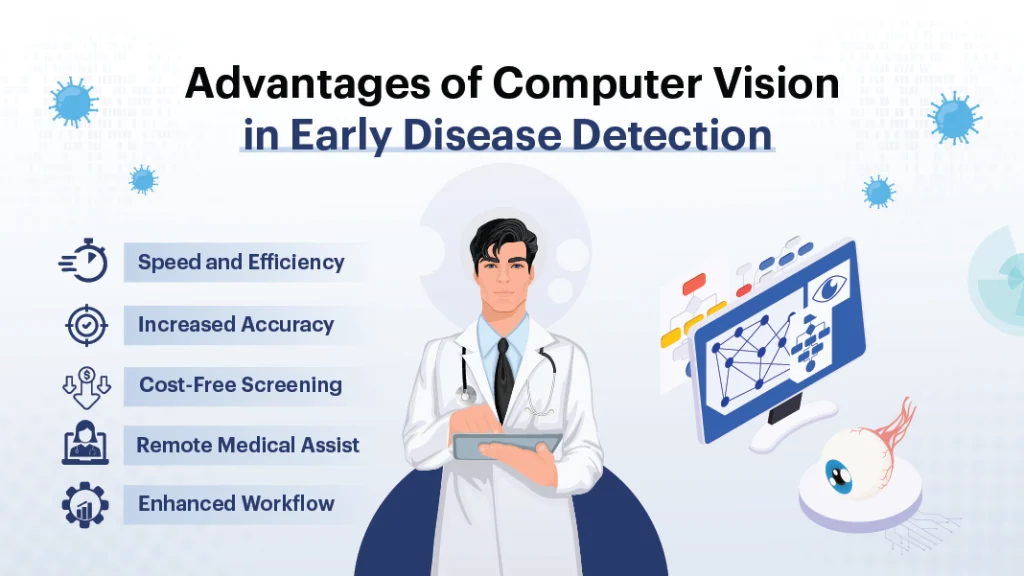
The inclusion of computer vision into medical diagnostics comes with several advantages:
- Speed and Efficiency: AI-based image analysis gives results in minutes, minimizing the wait for these patients.
- Increased Accuracy: Advanced algorithms decrease the probability of human error in diagnostics and increase the reliability of their results.
- Cost-Free Screening: Automated detection minimizes the use of costly diagnostic tests, making healthcare more affordable.
- Remote Medical Assist: AI telemedicine models make sure quality care reaches remote and underserved areas.
- Enhanced Workflow for Doctors: The entire process contributes to ensuring that healthcare professionals can focus on patients and not spend time interpreting images manually.
Challenges and Ethical Considerations
Though promising, computer vision in hospitals encounters somewhat of a challenge:
- Data privacy and security: The foremost concern is patient data protection.
- AI Model Bias: To the greatest extent possible, AI systems should be trained using datasets diverse enough to avoid biased results.
- Regulatory Obstacles: These slow down the adoption of AI medical tools due to very close approval processes.
- Integration with Healthcare Systems: Acceptance of technology requires smooth integration with existing medical infrastructures.
Conclusion
Computer vision is making its mark in the early detection of diseases and providing accurate diagnostic solutions that are fast and efficient and, therefore, cost-effective. From cancers and cardiovascular diseases to neurological disorders and infections, AI-based medical imaging technologies have paved the way toward a brighter tomorrow whereby diseases are detected earlier, treated effectively, and managed efficiently. As technology continues to grow, surely the integration of AI with healthcare will save lives and improve the health of people across the globe.
So, if you want to know more about it and want to get away from all kinds of queries, then you should get in touch with the professionals of Tekki Web Solutions now, as they have thorough details about everything that will, in turn, clear all your points.